

At the start of 2026, the Small Business Expo Research Desk analyzed survey responses from more than 900 small business owners regarding pricing strategy and cost pressures to assess small business pricing in 2026. Survey results suggest that the majority have raised prices or expect to, while a smaller but significant share report no plans to raise prices.
Rather than signaling hesitation, this pattern suggests that many owners are approaching pricing decisions deliberately, weighing near-term cost recovery against longer-term customer relationships while monitoring demand signals and competitive market dynamics closely.
Highlights
- 67.4% of small businesses have either raised prices recently or plan to
- 36.4% plan to raise prices but have not done so yet
- 32.6% say they are not planning to raise prices at all
- Cost pressure is widespread, yet price increases remain cautious
- Many owners appear to be balancing margin protection with customer retention
Most Small Businesses Expect to Raise Prices — Eventually
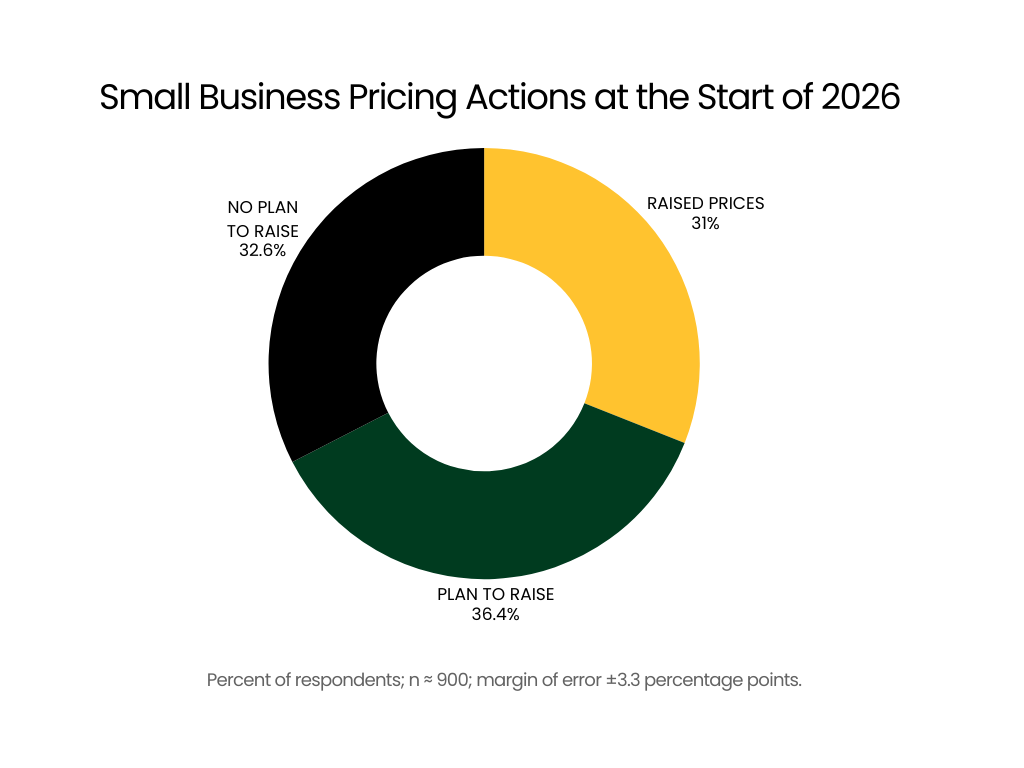
Respondents were asked whether they have raised prices in the past six months or plan to do so.
Price increase activity:
- 31.0% — Have already raised prices
- 36.4% — Have not raised prices yet, but plan to
- 32.6% — Have not raised prices and are not planning to
In total, 67.4% of respondents either have raised prices or expect to raise them, indicating that pricing adjustments are widely anticipated as the year begins. This pattern underscores how small business pricing in 2026 is being shaped by forward-looking planning, rather than short-term reaction to cost pressures alone.
This aligns with national research showing that price increases remain one of the primary tools small businesses use to offset rising operating costs. The Federal Reserve notes that pricing actions continue to be common among small firms facing margin pressure¹.
Yet One-Third Are Choosing Not to Raise Prices
At the same time, nearly one-third of businesses (32.6%) report that they are not planning to raise prices at all.
This hesitation is notable given that rising costs remain a widely reported challenge. It suggests that many business owners are concerned about:
- Customer price sensitivity
- Competitive pressure
- Losing market share
- Demand uncertainty
SCORE reports that many small business owners are “highly cautious about passing costs on to customers, particularly in competitive or discretionary markets”². This restraint underscores how pricing decisions are increasingly shaped by competitive positioning and customer behavior, not cost pressure alone.
Small Business Pricing in 2026 Is Strategic, Not Reactive
Importantly, the data does not suggest indecision — it suggests intentional restraint.
Businesses delaying price increases may be:
- Prioritizing customer loyalty
- Looking for internal efficiencies first
- Waiting for clearer demand signals
- Bundling or repositioning offerings instead of raising list prices
According to the National Federation of Independent Business, pricing decisions in early 2026 reflect “a strategic balance between protecting margins and maintaining customer relationships”³.
Pricing Pressure and Growth Can Coexist
What makes this finding especially interesting is that pricing hesitation exists alongside strong confidence and hiring intentions, as shown in other parts of the survey.
This reinforces that small business pricing in 2026 is being shaped by longer-term growth considerations, not solely by immediate cost recovery.
That combination points to a more sophisticated approach to growth, one that weighs long-term customer value against short-term margin protection.
Why This Insight Matters Right Now
Pricing is one of the most powerful—and sensitive—levers a small business can pull.
Early in the year, decisions about whether to raise prices can influence:
- Customer retention
- Revenue growth
- Cash flow stability
- Brand positioning
Understanding that many peers are proceeding cautiously may help business owners feel more confident taking a thoughtful, data-informed approach.
Final Takeaway
The final takeaway is clear: small business pricing in 2026 reflects a steady but strategic approach, with most businesses raising prices or planning to do so while balancing cost pressures against customer retention.
Most expect to, but many are waiting.
And that hesitation may reflect strategic discipline rather than fear.
Footnotes
- Federal Reserve. Small Business Credit Survey. https://www.fedsmallbusiness.org
- SCORE. Small Business Pricing and Cost Trends. https://www.score.org
- National Federation of Independent Business. Small Business Economic Trends Report. https://www.nfib.com